

I felt unexpectedly at home in Istanbul. Sometimes it was a flavour that evoked that sense of familiarity, like the sweet peanut dessert called halva, which took me back to my childhood. We have our own version in Argentina, which has a very similar taste.
Sometimes it was the local architecture. Istanbul underwent a process of Europeanization spearheaded by Mustafa Kemal Atatürk, the Founder of the Turkish Republic, in the 1920s and 1930s. Entire streets wouldn’t look out of place in Paris or Madrid or even my hometown of Buenos Aires, where generations of Spanish, Italian, and French architects have left their mark.
Turkish author and Nobel Prize winner in Literature, Orhan Pamuk, describes the city in his book, Istanbul, with a heavy dose of nostalgia and honesty. I lost myself in his book and in his city.
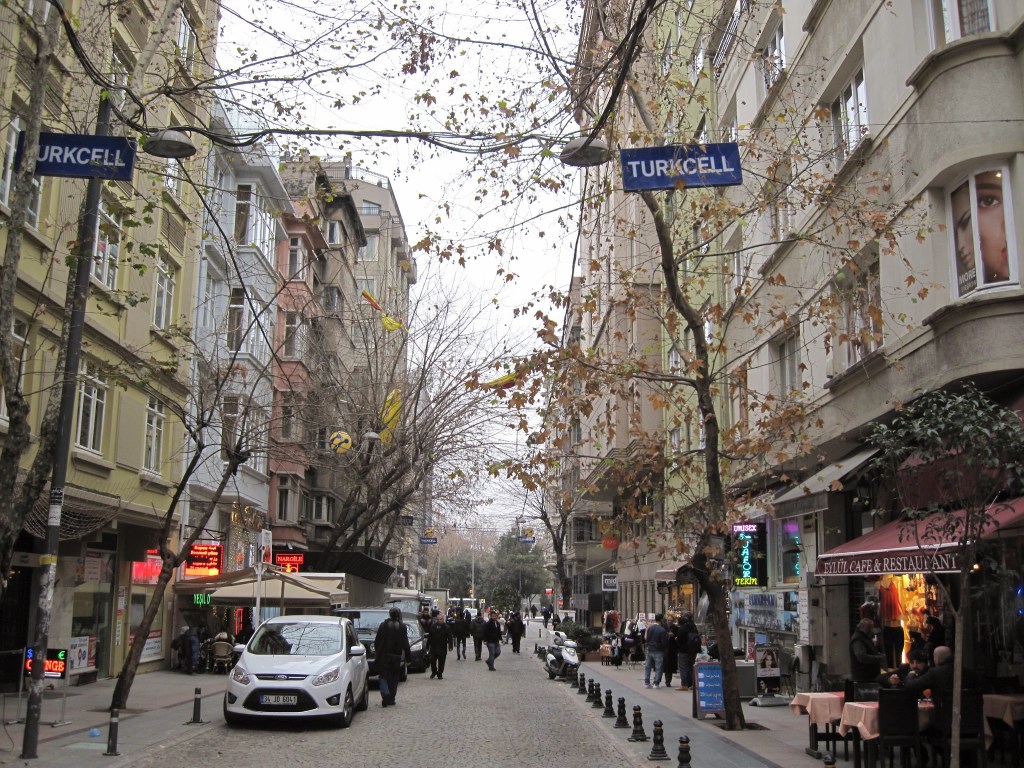
Pamuk writes about Istanbul as a city of ruins, whose inhabitants have embraced as a common fate, the melancholy brought about by the end of the Ottoman Empire and its faded glories. I see Istanbul as a woman going through a midlife crisis: her best years are behind her, the beauty of youth is fading, and she’s in the process of reinventing herself, trying to find a new identity and a new purpose. Something I can relate to.
Likewise, traces of the Ottoman Istanbul scattered here and there remind locals and visitors of a past that stubbornly clings to the present.
Stately yalis (Ottoman wooden mansions) perched on the edge of the Bosphorus. Or the tombstones of Ottoman dignitaries in the cypress-lined historic cemeteries that are topped with a turban or a fez to indicate a man’s rank or decorated with a flower for every child a woman gave birth to. The magnificent mosques. A fortress.
Walking is the best way to get to know a city. You share a bit of the locals’ daily activities; it gives you a glimpse into their daily lives. You can tell what is going on by looking at their faces and how fast they walk. One can learn a great deal about a town by pounding the streets.
I learned that it is culturally acceptable for men to walk arm in arm as a sign of friendship. It also applies to women. However, I did not see couples holding hands or kissing, which tells me that public displays of affection are frowned upon. Men and women socialize separately. Men gather at tea houses, where they while away the afternoon sipping tea, playing backgammon, and puffing away at their narghiles.
Men seem to dominate the streets and the trades. Street vendors, waiters, hotel receptionists, taxi drivers, and carpet sellers are mostly male. I also learned that people are not as aware of personal space in the way other people are. It was a little uncomfortable to have people walk so close behind me that when they took a step forward, they made me stumble, and were surprised when I looked daggers at them.
In some cultures, staring is considered rude. This may not be the case in Turkey, in my experience. People stared at us without shame and without hostility. It was a bit uncomfortable at first, but then it gave me carte blanche to stare back and observe them.
Men sport a short beard and wear dark clothes. These are the people in dark coats and jackets […] rushing home through the darkening streets, Orhan Pamuk writes about. Women also wear dark clothes, but their colourful veils put a cheerful note in their austere wardrobe. Some ladies have exotic (to me) features: striking high cheekbones and kohl-lined, almond-shaped eyes reminiscent of Scheherazade and all the magic and mystery of the legendary Levant.
Our hotel was close to the University of Istanbul, so the area was full of students coming and going along Ordu Caddesi, both on foot and on the tram. I felt a tiny bit envious of those students with their books and notes in hand. They can do anything they want; their life is still a blank book for them to write their own story. I wish I were that age again, with the world at my feet, but knowing what I now know. I noticed that a big proportion of those students were female, both veiled and unveiled.

That is the same tram line that goes to the Grand Bazaar and Sultanahmet Square, two of the most popular places to visit in the city, so passengers get on and off at every station. Traffic is dense, if rather chaotic at times. Horns are a constant feature all day long until late at night. While drivers always stop at the red light, pedestrians are more remiss. They take traffic lights as a mere suggestion and cross the street in a helter-skelter fashion.
Yet, in the middle of this apparent chaos, devout Muslim men calmly wash their feet and perform the ablutions prescribed by Islam before prayers five times a day. I admire the strength of their faith. Under no circumstance would I ever wash my bare feet in the open air on a wintry day like they do. Seeing this made me question my own religious faith and why I lost it.
Did I ever really believe in God? Did the beliefs I used to have come from my heart, or were they imposed from the outside? Probably the latter, especially when I was at Catholic school. I think some people need to believe in a Superior Being, and some don’t. However, I do sometimes find comfort in the ritual of Mass, in the communion with other people, and the energy it generates.
That´s the energy that courses through Istanbul when the muezzin’s calls to prayer reverberate throughout the city, bounce off ancient and new walls, and vibrate in my chest. It is the energy that brings the people, the past, and the present together.

 anaastrioreilly.com
Lovely post. I have a neighbor from Turkey and she is very warm and makes me feel at home even though she is new to the neighborhood. It’s a beautiful part of the culture, I think.
LikeLike
Laura, thank you for you kind comment and for stopping by!
LikeLike