

From the train, I can see one seemingly small turret on top of a hill. And then another. They are joined by a wall. The effect is that of a saddle. They are so high up that it makes me wonder how I will ever reach the castle. The train comes to a halt at Sintra, the end of the line. I look up: the turrets don’t look any closer. Maybe taking the bus is a good option.
Once I pay for my ticket at the ticket office housed in a trailer, I follow the signs and go through the turnstile. I walk past some workers manning a zip line that allows them to bring up wood planks and other construction materials from down below for restoration work at the castle. I follow the signs along the path.
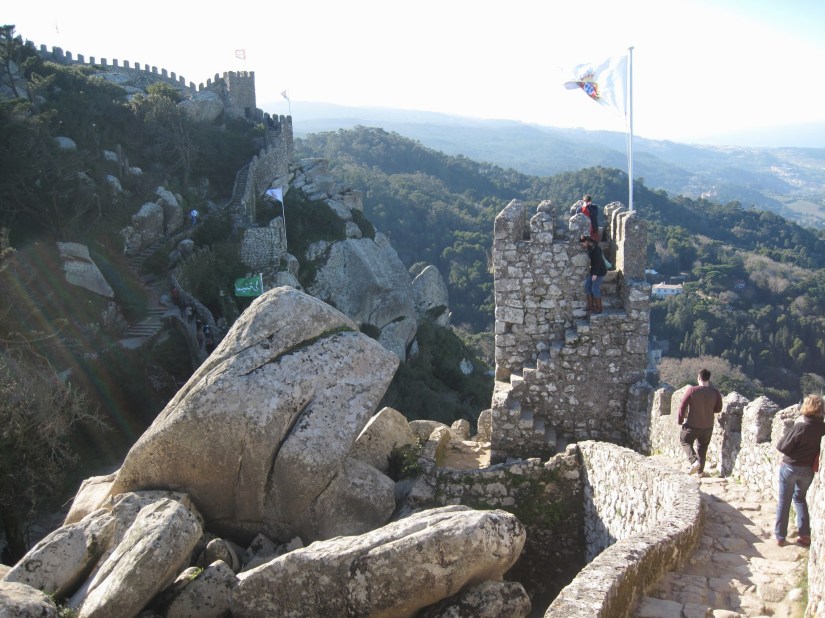
I walk past the chapel and a memorial, the medieval tombs, the big stone silos, and the water cisterns on my way towards the battlements. I’m amused by the Traitors’ Gate, an impossibly small entrance. I wonder how it got its name.
Once I reach the battlements, I can see undulating land disappearing in the distance beyond the stone walls. The Portuguese flag and the Moorish banner flutter in the cool winter breeze. It feels damp and cold in the shade but warm out in the sun. The turrets and the keep glow in the afternoon light, in sharp contrast with the darkness created by the dense vegetation below.
The battlements are narrow and low, and the stone steps, worn. There are no railings either. It is quite an adventure to go from one turret to another. If somebody is coming in the opposite direction, one of you will have to flatten against the wall to give way to the other.
The Moorish invaders began to build what is now known as the Moorish Castle (Castelo dos Mouros) in the 8th century. Its vantage point at the top of the hill is a perfect defensive position. It’s easy to imagine the sentries marching along the walls, keeping an eye out for the Christian armies.
And it is equally easy to picture the hosts of King Afonso VI swarming up the hills in 1093 in a successful attempt to take Sintra from the Moors. The fortress changed hands between Moors and Christians a few times more until Dom Afonso Henriques (the first king of Portugal) conquered Lisbon in 1147, when the Moors surrendered the castle to him.
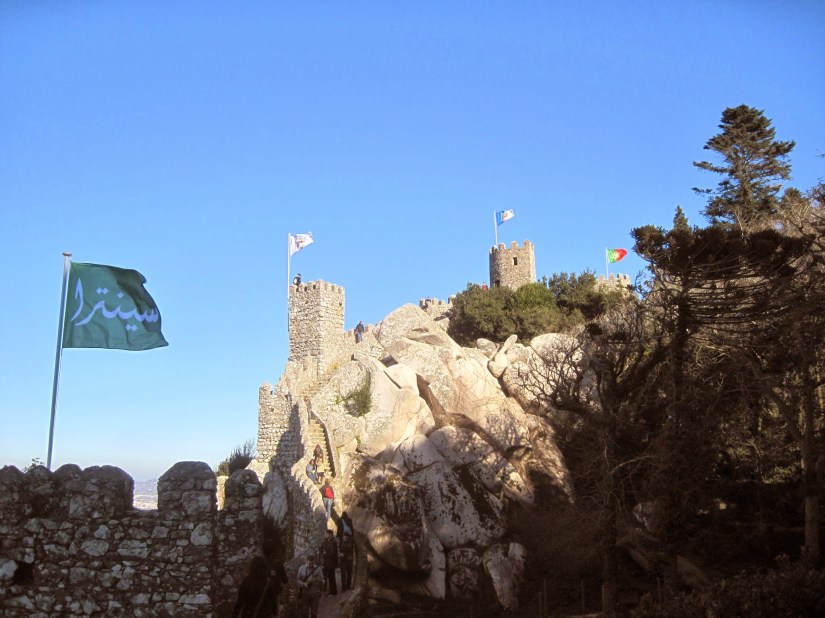
The Moors were able to withstand a siege with fresh water from the springs, which they channelled into the cisterns, with the grain stored in the silos, and because the castle was impregnable. However, it was impregnable on only three sides. Its Achilles heel is the sloping woods. It’s not difficult to see how Dom Afonso was able to override their defenses and storm the fortress. The chapel of S. Pedro de Canaferrim was added to the castle after the conquest as the parish seat.
The castle, as so much in Portugal, is an intriguing mix of Christian and Moorish.
Getting there
Sintra lies about 20 miles northwest of Lisbon.
Rossio Station (Linha de Sintra) is a 39-minute ride. The train runs every 15 minutes.
At Sintra Station, take the number 434 bus to Castelo dos Mouros. It runs in a loop called Circuito da Pena. It goes up and down the hill, stopping at each attraction. The castle can be reached on foot from Sintra, but the lack of sidewalks and too many bends make it somewhat treacherous. The bus is a safer and faster option.

 anaastrioreilly.com