

2024 marks the 150th anniversary of the publication of Far from the Madding Crowd (1874), Thomas Hardy’s first successful novel. It was initially published in serial form in Cornhill Magazine throughout 1874 and republished in two volumes by Smith, Elder, later that year for the first time.
Thomas Hardy was born in the Dorset countryside in 1840. As a child, he became familiar with the natural cycles of the countryside and its time-honoured traditions, which greatly influenced his writing. Far from the Madding Crowd reflects those early influences in different ways and is also considered a pastoral novel.
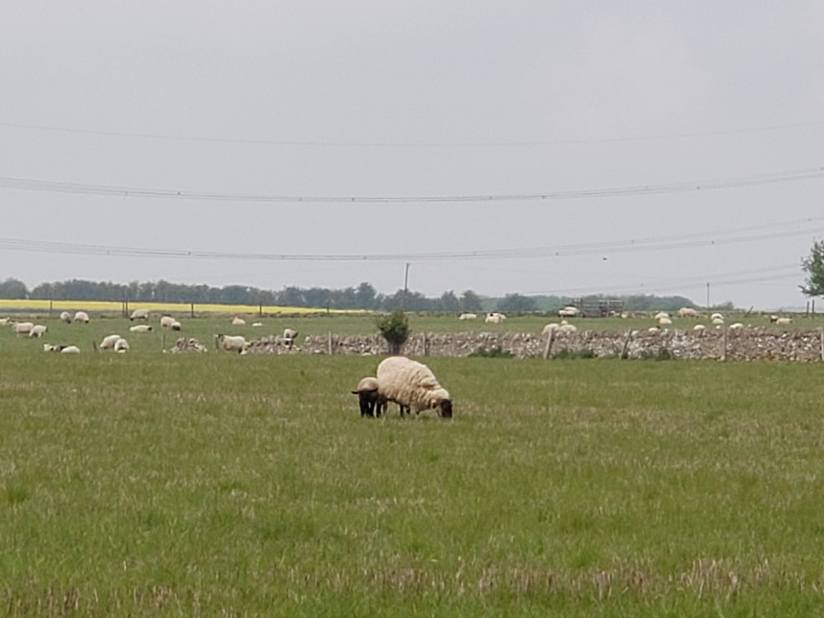
In essence, pastoral literature is about sheep and shepherds and their love interests. The stories take place in a dreamy, idealized world like the Arcadia of the classical Golden Age, which, according to R. P. Draper, “was a time when the natural world was a perpetual spring and summer of fertility; the seasonal change was unknown.”1 Hardy created his own Arcadia-like place, but he also included the harsh realities of country life, like misfortunes, accidents, the effects of the seasons in nature and human activity, the contrast between city life and country life, and the threat posed by modernity to old traditions. He called this place Wessex.

In the preface to the 1902 edition of Far from the Madding Crowd, Hardy explains that he chose to create the imaginary county of Wessex as “the series of novels I projected being mainly of the kind called local, they seemed to require a territorial definition of some sort to lend unity to their scene.”2 In this fictional world, he was able to represent different kinds of country folk, immortalise the dying traditions of the countryside, and manipulate the descriptions of nature to support the action, as well as decrying the damaging influence of modern urban activity on the countryside.
What I found interesting in Hardy’s descriptive writing is how nature reflects the characters’ moods. For example, in chapter 42, we read about Joseph Poorgrass fetching Fanny’s body from the Casterbridge Unionhouse to be buried in the village church of Weatherbury. Hardy made the weather as bleak as the task. Joseph’s mood, and ours along with his, also becomes melancholic as the autumnal afternoon wears on.
The way Hardy describes the fog reminds me of the gothic aesthetic of Dracula by Bram Stoker (1897), especially when Poorgrass looks towards the sea and “saw strange clouds and scrolls of mist rolling over the long ridge.”3 In both stories, the sea takes on a sinister air. Also, the creeping fog creates a claustrophobic atmosphere in Yalbury Great Wood, which Poorgrass must cross to get to Weatherbury, “by the time that horse, man, and corpse entered Yalbury Great Wood, these silent workings of an invisible hand had reached them, and they were completely enveloped,.”4 The fog’s relentless advance seems to signify the inescapable fate of characters like Fanny or Boldwood, who were doomed from the start, as well as adding a pall of gloom to the scene.
Fanny Robin had a love affair and a child out of wedlock with Sargent Troy. In her defense, she thought they were going to get married, but fate intervened, and they did not wed. As an unmarried woman who had sinned, at least in the eyes of Victorians, she would have been considered a fallen woman and shunned from society. The description of the air inside Yalbury Great Wood suggests to me the sort of hopeless social limbo these ladies must have experienced: “The wagon and its load rolled no longer on the horizontal division between clearness and opacity but were embedded in an elastic body of a monotonous pallor throughout.”5 Rejected by society, they had nowhere to go and no one to turn to. The trees that “waited longingly for a wind to come and rock them”6 make me think of a desperate Fanny waiting for Troy outside the church, clinging to a dire hope.
Some of the literary devices Hardy used in this passage are personification, as in “the trees stood in an attitude of intentness;”7 similes, as in “The air was as an eye suddenly struck blind;”8 auditory imagery, like the crunching of the wheels and the rustling of leaves or the absence of sound: “A startling quiet overhung all surrounding things.”9 or visual imagery: “shadowless and specter-like in their monochrome of grey.”10 “Joseph Poorgrass looked round upon his sad burden”11 is an example of synaesthesia that tells us that Joseph was sad and that we should be, too.
In contrast to this sombre atmosphere, the description of the sheep-washing activities in chapter 1912 paints a cheerful picture of spring, a time of renewal and hope.
By all accounts, Hardy read the classics and was familiar with Greco-Roman mythology, which he referenced in his work. In the description of the sheep-washing pool in the meadows, Hardy compares it with “a glistening Cyclops’ eye in a green face”13 when the still water reflects the sky and can be seen from above. Cyclops were one-eyed giants whom Homer represents as uncivilised shepherds14, which ties in with the novel’s pastoral theme.
Could the green face be that of the Cyclops, the colour green referring to the grass surrounding the pool? Or could it be another cultural reference? I think it can be a reference to the Green Men15, the foliate heads usually carved on medieval religious buildings. Although the Green Man was a pre-Christian figure, it was widely popular in the Middle Ages as a symbol of fertility, rebirth, and resurrection. Also, the use of the Green Man image ties the real, old Wessex with the fictional Wessex and lends certain legitimacy to it.

The adjectives Hardy uses in this passage16 are positive; for example, “clearest water”, “the rich damp sod”, “the swelling reeds”, and “the leaves of which were new, soft, and moist”. They also represent different kinds of imagery, like visual or tactile. Images like these contribute to the overall mood of this passage, which is upbeat and dynamic. Other literary devices used in this passage include simile (the river as a shade), auditory images (the cuckoos singing), kinaesthetic imagery (the rolling flagons of cider), and antimetabole (“their colour being yellow beside a green- green beside a yellow”17).
As a child, Hardy18 acquired an appreciation for church rituals, although as an adult, he had a fluctuating interest in religion. In my opinion, the washing of the sheep scene shows the rural customs of the day, but it also symbolizes the rite of baptism.
The sheep had to be washed to remove dirt before shearing. That was the practical purpose of this operation. The shepherds push the sheep into the pool and Gabriel “thrust them under as they swam along”19. Then, the sheep swim upstream and get out, “all impurities flowing away below”20. This is redolent of the rite of Christian baptism. This ritual immersion in water symbolises the cleansing of sins and the person’s rebirth as a Christian. The sheep-washing basin is the baptismal font, and Gabriel Oak represents the priest who leads the ritual.
The flock of sheep can also be interpreted as a religious image. In John 10:1-21, in the King James Version, Jesus Christ refers to himself as the good shepherd who lays down his life for the sheep, protects them from evil, and leads them to salvation. The sheep, in this case, means his followers, and a congregation is usually referred to as a flock. The Christian clergy and laity carry out pastoral care, providing social, emotional, and spiritual support. Much like Gabriel Oak, they look after the well-being of their flock.
Reference list
1 R. P. Draper, and Ronald Draper. “Hardy and the Pastoral.” (The Thomas Hardy Journal, vol. 14, no. 3, 1998, pp. 44–56. JSTOR, http://www.jstor.org/stable/45274403 Accessed 7 Mar. 2024)
2 Thomas Hardy, Far from the Madding Crowd, (London: Penguin Popular Classics, 1994) Preface p. V.
3Hardy, Far from the Madding Crowd, p. 264.
4 Hardy, Far from the Madding Crowd, p. 264.
5 Hardy, Far from the Madding Crowd, p. 264.
6 Hardy, Far from the Madding Crowd, p. 264.
7 Hardy, Far from the Madding Crowd, p. 264.
8 Hardy, Far from the Madding Crowd, p. 264.
9 Hardy, Far from the Madding Crowd, p. 264.
10 Hardy, Far from the Madding Crowd, p. 264.
11 Hardy, Far from the Madding Crowd, p. 264.
12 Hardy, Far from the Madding Crowd, p. 122, 123
13 Hardy, Far from the Madding Crowd, p. 122
14 Cyclops entry in the Encyclopedia Britannica https://www.britannica.com/topic/Cyclops-Greek-mythology (Accessed 16 Mar. 2024)
15 Historic UK, The Green Man. Available at https://www.historic-uk.com/CultureUK/The-Green-Man/ (Accessed 16 Mar. 2024)
16 Hardy, Far from the Madding Crowd, p. 123
17 Hardy, Far from the Madding Crowd, p. 122
18 Thomas Hardy’s entry in the Oxford Dictionary of National Biography online https://www.oxforddnb.com/display/10.1093/ref:odnb/9780198614128.001.0001/odnb-9780198614128-e-33708
19 Hardy, Far from the Madding Crowd, p. 123
20 Hardy, Far from the Madding Crowd, p. 123

 anaastrioreilly.com